
Quote

Tell us the date, venue and how many people.

Your contact. A senior coordinator reads your message, prepares the proposal and is at the venue on the day of the event.

This site is protected by reCAPTCHA and the Google privacy policy and terms of service apply.

Privacy policy

Review how we handle your data before sending the form.

1. General information

In compliance with Regulation (EU) 2016/679 of the European Parliament and of the Council of 27 April 2016 on the protection of natural persons with regard to the processing of personal data and on the free movement of such data (GDPR), and with Organic Law 3/2018, of 5 December, on the Protection of Personal Data and Guarantee of Digital Rights (LOPDGDD), we hereby inform you about the processing of your personal data.

2. Data controller

The controller of your personal data is:

  • Company name: Aptia Servicios de Consultoría S.L.
  • Tax ID (NIF/CIF): B19954890
  • Registered office: Sagasta 6, 36001 Pontevedra, España
  • Email: info@aptia.es
  • Phone: +34 662 107 062

3. Personal data we collect

We collect and process the following types of personal data:

3.1 Identification data

  • First name
  • Surname
  • Company

3.2 Contact data

  • Email address
  • Phone number

3.3 Browsing data

  • IP address
  • Browsing data and cookies (see our Cookie Policy)
  • Website usage data (pages visited, time spent on the site, etc.)

3.4 Communication data

  • Messages and enquiries sent through forms
  • Service of interest
  • Event date and location
  • City of residence and experience, for job applications

4. Purposes of processing

Personal data are collected and processed for the following purposes:

4.1 Handling enquiries and requests

  • Answering enquiries and requests for information received through contact forms
  • Providing quotes and commercial information
  • Maintaining the business relationship with clients and potential clients

4.2 Managing resource downloads

  • Providing access to downloadable resources (PDFs, guides, etc.)
  • Sending download links to the email address provided
  • Managing contacts interested in our resources

4.3 Commercial communications

  • Sending commercial communications (with express consent)
  • Providing information about news, services and content of interest
  • Managing marketing campaigns

4.4 Website analysis and improvement

  • Analysing user behaviour on the website
  • Improving the user experience
  • Statistical and web traffic analysis

4.5 Compliance with legal obligations

  • Compliance with tax and accounting obligations
  • Retention of documentation in accordance with applicable legislation

4.6 Handling job applications

  • Handling job applications received through the Work with us form (name, contact details, city and experience), based on the data subject's consent

5. Legal basis for processing

The processing of personal data is based on the following legal grounds under Article 6 of the GDPR:

  • Consent of the data subject (Art. 6(1)(a) GDPR): For sending commercial communications, handling job applications and for the use of non-essential cookies. Consent may be withdrawn at any time.
  • Taking steps prior to entering into a contract (Art. 6(1)(b) GDPR): For handling enquiries, requests for information and quotes.
  • Legitimate interest (Art. 6(1)(f) GDPR): For maintaining the business relationship, improving our services, statistical analysis and contact management.
  • Compliance with a legal obligation (Art. 6(1)(c) GDPR): For compliance with tax, accounting and document retention obligations under applicable legislation.

6. Data retention

Personal data will be retained for the following periods:

  • Contact form data: For as long as the business relationship is maintained and, where applicable, for the periods established by applicable legislation (6 years for commercial and accounting records, under Article 30 of the Spanish Commercial Code, and 4 years for tax obligations, under Article 66 of Law 58/2003, General Tax Law).
  • Download form data: For as long as the business relationship is maintained or until the data subject requests their erasure.
  • Job applications: One year from receipt, unless you withdraw your consent earlier. After that period they are deleted.
  • Commercial communications: Until the data subject withdraws their consent or unsubscribes.
  • Browsing data and cookies: As specified in our Cookie Policy.

Once the retention period has ended, the data will be securely erased, unless a legal obligation requires their retention.

7. Disclosure of data to third parties

Personal data will not be disclosed to third parties, except in the following cases:

  • Where necessary to provide the requested service (technology service providers, email delivery platforms, etc.).
  • Where there is a legal obligation.
  • Where the user has given their express consent.

7.1 Data processors

Aptia uses the following data processors to manage data:

7.2 International transfers

Personal data may be processed by services located in the European Union (such as Brevo, based in France). Should international transfers outside the European Economic Area take place, it will be ensured that they are made to countries with an adequate level of protection recognised by the European Commission or under the appropriate safeguards set out in the GDPR (standard contractual clauses, EU-US Data Privacy Framework, etc.).

8. Data subject rights

In accordance with the GDPR and the LOPDGDD, you have the right to:

  • Access (Art. 15 GDPR): Obtain confirmation as to whether we are processing your personal data and, where that is the case, access them.
  • Rectification (Art. 16 GDPR): Request the correction of inaccurate or incomplete data.
  • Erasure (Art. 17 GDPR): Request the deletion of your data when they are no longer necessary for the purposes for which they were collected or when you withdraw your consent.
  • Restriction of processing (Art. 18 GDPR): Request the restriction of the processing of your data in certain circumstances.
  • Portability (Art. 20 GDPR): Receive your data in a structured, commonly used and machine-readable format, and transmit them to another controller.
  • Objection (Art. 21 GDPR): Object to the processing of your data where the processing is based on legitimate interest.
  • Withdrawal of consent: At any time, where the processing is based on consent, without affecting the lawfulness of processing based on consent before its withdrawal.

To exercise these rights, you may contact us at:

  • Email: info@aptia.es
  • Postal address: Sagasta 6, 36001 Pontevedra, España

Your request must be accompanied by a copy of your identity document or an equivalent proof of identity, and must state the right you wish to exercise.

You also have the right to lodge a complaint with the Spanish Data Protection Agency (Agencia Española de Protección de Datos, AEPD) if you consider that the processing of your personal data does not comply with the regulations in force. You can contact the AEPD at:

  • Website: www.aepd.es
  • Phone: 912 663 517
  • Address: C/ Jorge Juan, 6, 28001 Madrid

9. Security measures

Aptia has adopted the technical and organisational measures necessary to ensure the security of personal data and to prevent their alteration, loss, or unauthorised processing or access, taking into account the state of the art, the nature of the data stored and the risks to which they are exposed.

The measures implemented include:

  • Encryption of data in transit (HTTPS/TLS)
  • Access control and authentication
  • Regular backups
  • System security updates
  • Staff training in data protection

10. Minors

Our services are not intended for children under 14, the age from which Article 7 of the Spanish LOPDGDD allows a person to consent to the processing of their own data. We do not knowingly collect data from children under 14 without the consent of their parents or legal guardians. If you become aware that a minor has provided personal data without that consent, please contact us so that we can delete it.

11. Changes to the privacy policy

Aptia reserves the right to amend this privacy policy at any time. Changes will be published on this website, indicating the date of the last update.

We recommend that you review this privacy policy periodically to stay informed of any changes.

12. Contact

For any questions about this privacy policy or the processing of your personal data, you can contact us:

  • Email: info@aptia.es
  • Phone: +34 662 107 062
  • Address: Sagasta 6, 36001 Pontevedra, España

You can also consult our Legal Notice and our Cookie Policy.

event coordination

Event coordinator: what they do and when you need one

What a corporate event coordinator actually does, when it is worth hiring one and how to tell whether the one in front of you is any good.

Aptia Team6 min read

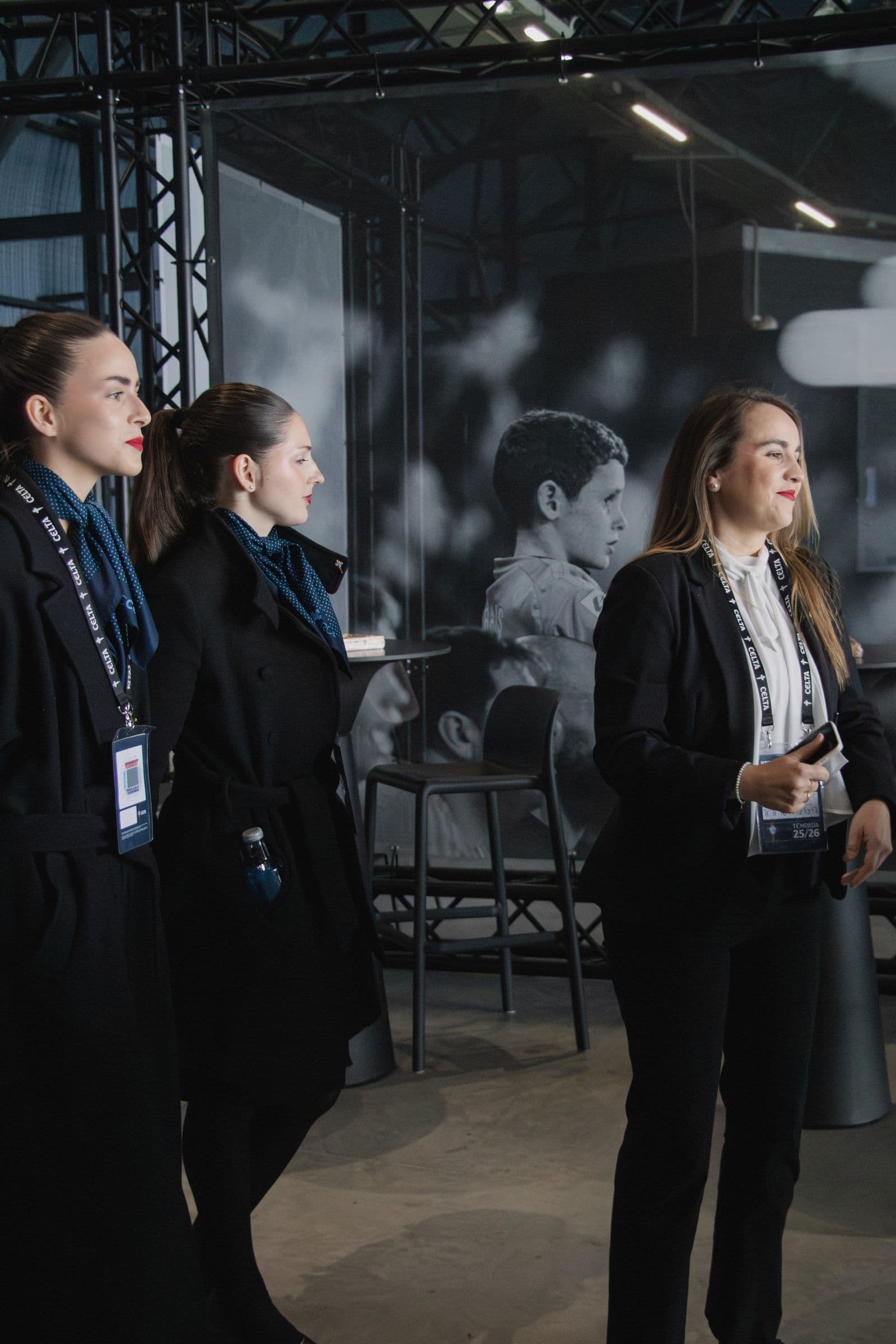
Aptia coordinator and accredited hostesses in the hospitality area

Imagine a medical congress in Santiago. It is Friday, 17:40, and 340 delegates are waiting for the closing talk when the projector in the main room stops working.

The venue technician is not answering the phone, the organiser is looking after the sponsors in another room and the speaker is waiting at the lectern.

If you have a coordinator, they know who else to call at the venue to get the technician there as soon as possible. They reassure the speaker, ask the room staff to keep the delegates informed and only go looking for the organiser if a decision is needed, such as delaying the close. If you do not have one, it falls to you, or nobody deals with it and 340 people sit staring at a blank screen while someone hunts for a phone number.

An event coordinator is there to stop problems from reaching you, which goes well beyond "helping with the organisation".

The confusion comes from the fact that the title is used for everything. Some job adverts with that name are really looking for someone to set out chairs, while other roles involve leading a team of 15 people over several days.

The real job

The coordinator does not organise the event, because you or your agency have already done that. Their job is to make sure the plan is carried out on the day, with the staff in place and information flowing between the organisers, the suppliers and the team.

They lead the staff. If you have hostesses and hosts, assistants or accreditation staff, someone has to make sure each of them is at their post, knows what to do and has their shifts and breaks covered. This is the core of the job.

They put the schedule into practice. Your schedule says "16:00: coffee break". For the coordinator, that means having staff in position to direct delegates towards the hall, checking with the caterer that everything is on time and letting the right person know if there is a delay.

They act as the link. At an event there are many suppliers talking to many people in your company, which leads to confusion, contradictory decisions and messages that get lost. The coordinator is the point of contact between the organisers, the suppliers and the staff, so that each message reaches the right person and only what needs your attention reaches you.

They solve problems without escalating them. Most event problems are small, such as a speaker who cannot find the room, a post left uncovered or a room where the air conditioning is too strong. The coordinator solves whatever is in their team's hands, alerts the relevant venue or supplier about the rest and only passes on to you what genuinely needs your decision.

When you need one

You do not always need one. Some events you can manage yourself without any trouble.

You probably do not need one if:

  • It is an internal event with fewer than 30 people
  • It lasts less than 4 hours
  • There is only one external supplier (or none)
  • You can keep an eye on operations without neglecting the attendees

You probably do need one if:

  • There are more than 80 attendees
  • It lasts more than one day
  • Three or more suppliers are working at the same time
  • You have to act as host and cannot be solving problems
  • The cost of something going wrong is high (an event with important clients, the press or public institutions)

Ultimately the test is simple. Can you afford to be dealing with incidents when you should be talking to the managing director who has come up from Madrid?

How to tell whether the one in front of you is good

There are three signs that help.

1. They ask you awkward questions.

A poorly prepared coordinator says "fine, perfect" to everything. A good one asks what happens if the speaker cancels, who has the key to the press room or whether there is a plan B for the catering if it rains and the terrace cannot be used.

If the preliminary meeting does not make you think about things you had not considered, that is a bad sign.

2. They know the venue.

Some things are not written down anywhere, such as where the working sockets are, how long the goods lift really takes or which door you use to get in before the venue opens.

A coordinator who has already worked at that venue has an advantage. One who has worked at many knows what to ask when they arrive at a new one.

3. They can give you specific references.

"I have coordinated lots of events" is not enough. It has to be something concrete, such as "I coordinated congress X in 2023, with 400 delegates over three days. Talk to Y if you want to hear how it went".

If they are unwilling to give references, or only give vague ones, be wary.

What the service should include

If you hire external coordination, make sure the quote includes:

  • A preliminary meeting (not on the day of the event)
  • An operational schedule (the internal document with people responsible and phone numbers, not the programme for attendees)
  • Full presence (from before the start until after the close)
  • A follow-up report (what happened, what incidents occurred, what can be improved)

If any of these is missing, ask why or look for another supplier.

The cost of not having one

Companies are investing more and more in events because they deliver results. They generate contacts, help close sales and strengthen the brand image. An event that goes wrong achieves exactly the opposite, and "going wrong" is often not an obvious disaster but a string of small failures that leave a bad taste, such as the queue to get in, the microphone that did not work, the speaker who started late or the catering that ran out.

What a coordinator costs depends on the hours and days of the event, the experience required and the size of the team they have to lead. Travel and subsistence costs also play a part, as do whether the dates fall in high season and how far in advance you book. In any case, it is usually a small share of what you have already invested in the event. The most practical approach is to ask for a quote based on the details of the event.

One last thing

You are the one in charge. The coordinator carries things out so that you can focus on what matters, which is the attendees, the content and the relationships.

If you finish an event thinking "thank goodness [coordinator's name] was there", you hired well. If you finish thinking "I had to keep an eye on everything myself", the coordination did not work.

We work at events all over Galicia. If you need staff coordination for a congress, a corporate day or any other event in Vigo, Santiago, A Coruña or the surrounding area, let us talk. We know the venues and the usual problems, and we know when to call you and when to sort it out without bothering you.

Quote

Did you find this article useful?

If you have an event in mind, tell us and we'll help you prepare it.

  1. Today

    Write to us with whatever you know, even if some details are missing.

  2. 24 h

    We send you profiles, schedules and a fixed price.

  3. Until the end

    The same contact person until the event is over.

Your contact. A senior coordinator reads your message, prepares the proposal and is at the venue on the day of the event.

This site is protected by reCAPTCHA and the Google privacy policy and terms of service apply.